
Expert Centre network
Bipolar disorders
Up to 2.5% of the French population, and still diagnosed on average ten years too late.

Understanding the disorder
What research is already changing
- Biological markers for diagnosis, prognosis and treatment choice
- Identifying homogeneous subgroups of patients, to replace a category that is too broad to be useful
In figures
- Between 1% and 2.5% of the population — 650,000 to 1,650,000 people in France
- Onset mostly between 15 and 25 years old
- Ten years on average between the first episode and appropriate treatment
- Ranked sixth worldwide among causes of disability by the WHO
- Life expectancy reduced by around ten years
- Genetics accounts for about 60% of the origin; a child of one affected parent has around a 10% risk, rising to 30% if both parents are affected
- Cognitive difficulties in 30 to 50% of patients; metabolic syndrome in 20%, twice the general population
Bipolar disorder alternates periods of depression with periods of abnormally elevated mood. It is chronic: you do not recover from it, you remain vulnerable to it for life. Between episodes a person can function entirely normally — which is part of why the diagnosis is so often missed.
It usually appears between 15 and 25, and most often announces itself with a depressive episode, not a manic one. That is the trap: an estimated 40% of people treated for depression may in fact have bipolar disorder, and the wrong treatment can make it worse.
The delay matters. The years before diagnosis are the years in which education, work and relationships are most damaged, and 20% of people with untreated bipolar disorder die by suicide.
What it looks like
- Manic phases: sleeplessness without fatigue, irritability, anger, emotional hyper-reactivity, risk-taking in spending, sex or substances
- Depressive phases: overwhelming fatigue, disrupted memory and attention
- Throughout: difficulty regulating emotions, associated anxiety disorders, cognitive impairment, disturbed sleep — more than eight in ten patients in remission report sleeping badly
What contributes
- Complex heredity — genetics accounts for around 60%
- Stress and painful life events, the leading trigger
- Premature birth or a difficult delivery
- Physical, emotional or sexual violence in childhood or adolescence
- Cannabis and alcohol, acting as catalysts
- Disrupted rhythms: night work, sleep deprivation, jet lag, childbirth
- Raised immuno-inflammatory markers; early, prenatal or perinatal infection
Getting help
For bipolar disorders, a dedicated network of Expert Centres offers the same two-day assessment everywhere in France, and sends a written plan to your own doctor.
The pathway, step by step
Referral
Your psychiatrist or GP refers you to the centre nearest to you. The Expert Centre does not replace your usual care — it supports it.
Two days of assessment
A multidisciplinary team carries out a standardised evaluation: clinical interviews, neuropsychological testing, biological and metabolic work-up, and a review of treatment history.
A written set of recommendations
Personalised diagnostic and treatment recommendations are sent to your referring physician, who remains responsible for your care.
Follow-up over time
You may be offered a follow-up assessment in later years. With your agreement, some of the data collected during the assessments can also contribute to research. Your choice has no effect on your care.
Assessments are covered by the French health system under the usual conditions. Waiting times vary by centre and by network.
Expert Centre network
On medical referral only
Expert Centres see people referred in writing by a psychiatrist (or, depending on the centre, by a GP). They do not take appointments directly: talk to your doctor first.
How to be referred →Your location stays on your device: it is neither sent nor stored.
17 expert centres shown
Pinch to zoom on a touchscreen, scroll or use the buttons on a desktop, drag to move around. The full list is below the map and works without it.
Living with it
Tools the foundation built or supports, for patients and for the people around them.
To download
 E-bookBipolar disorders: research advances in 2026Our free e-book, with the Expert Centre teams and the Argos 2001 association · PDF, 30 pages, in French
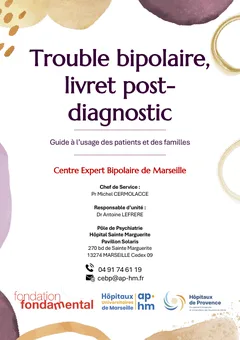 Patient guideBipolar disorder: after the diagnosisA guide for patients and families, by the Marseille Bipolar Expert Centre · PDF, 51 pages, 9.6 MB, in French
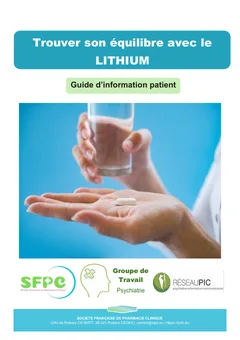 Patient guideFinding your balance with lithiumA patient information guide from the French Society of Clinical Pharmacy (June 2025) · PDF, 20 pages, in French
SIMPLe+
A psychoeducation and self-assessment app for people living with bipolar disorder.
Read the pageeBREF
An app that starts and speeds up the journey of people caring for someone with a mental illness. It extends the BREF programme — three one-hour sessions — with information on disorders and treatments, and a map of nearby family associations, BREF sites and Expert Centres.
apps.apple.com/fr/app/bref-aidants/id1557740835Léo 2.0
A digital psychoeducation programme: a secure space for carers to learn and look after themselves, with interactive modules on communication techniques and stress reduction, open around the clock and free.
leo.lmsdokeos.com/fr/users/sign_inFood4Mood
A mobile app that helps people prevent or manage depression through nutrition programmes whose effect on depression has been scientifically validated, built on the Mediterranean diet.
Read the pagePeaceOfMinds
Psychological support for people affected by the Israel–Hamas conflict: self-assessment of psychological difficulties, tools for managing symptoms, and country-by-country resources.
peaceofminds.info/fr
You look after someone? Léo 2.0 and eBREF were made for carers. All platforms and apps
In distress, or worried about someone? In France, call the national suicide prevention line, free, 24/7:3114
Research is moving
What the foundation's teams have established about bipolar disorders, and the projects under way.
What we know
- Biological markers for diagnosis, prognosis and treatment choice
- Identifying homogeneous subgroups of patients, to replace a category that is too broad to be useful
- Chronobiology: sleep and rhythm abnormalities that predict relapse
- Imaging: abnormalities of the amygdala and hippocampus
- Immunology, which is beginning to explain the physical comorbidities
Projects and trials
Passport BP
2,000 patients with bipolar disorder followed for three and a half to four and a half years.
Genetics & Psychiatry
International studies on vulnerability genes in bipolar disorder and schizophrenia.
Cohort-Biobank
Biological samples linked to clinical data across the Expert Centre network.
Immuno-metabolism
The overlap between metabolic syndrome and psychiatric illness.
Projects to support on this condition
Therapeutic trials
Photobip: photobiomodulation and bipolar disorders
A clinical and translational research project to evaluate the effect of a non-invasive photobiomodulation (PBM) device in the treatment of bipolar disorders.
Research area · Clinical trials
See the projectBiomarker research
Environmental risk factors and mental illness (PolluPsy)
A case-control study to determine whether exposure to air pollution — over the whole life, then during the periods of neurodevelopment — increases the risk of schizophrenia, bipolar disorder or autism spectrum disorder.
Research area · Pollution and climate
See the projectStructural actions
Biobank / cohorts
Strengthening the four patient cohorts followed in our Expert Centres — schizophrenia, bipolar disorders, treatment-resistant depression, autism spectrum disorders without intellectual disability — and the associated biobank, alongside the French Minds cohort: 2,500 patients across 33 centres.
Research area · Our cohorts
See the project
Continue
More news
Research brief
Bipolar disorders: mild hypomanic symptoms do not seem to improve cognitive abilitiesResearch brief
Bipolar disorder: better understanding the impact of anxiety and addictions to personalise treatmentPodcast
Can genetics transform psychiatry?In the press
Midi Libre | Trouble bipolaire : symptômes, phases, idées reçues… pourquoi ce n’est pas une "montagne russe" permanenteResearch brief
Suicide: different biological signatures depending on the psychiatric disorder and the type of suicide riskIn the press
Le Progrès | Troubles bipolaires : quels sont les signes qui doivent alerter ?Research brief
Bipolar disorder: treatments whose mechanisms are still poorly understoodIn the press
Handicap.fr | Bipolarité : comment avance la recherche ?
Read more
Become a donor