
Research area 5 of 10
Our cohorts
- FACE
- BIOFACE
- I-Give
- French Minds
Cohorts are one of the benchmark tools of public health research. We lead the FACE cohorts, drawn from the Expert Centres, and the French Minds cohort, launched as part of the French Priority Research Programme and Equipment in precision psychiatry (PEPR PROPSY), which together will form one of the largest multimodal databases in psychiatry in the world. We also run the BIOFACE biocollection and the I-Give study.

Research objectives
In Europe, more than 80 million people — 27% of the population — are affected by a mental disorder in the course of their life. Severe psychiatric disorders (bipolar disorders, major depression, schizophrenia) and autism spectrum disorders shorten life expectancy by 15 to 20 years and represent, in France, an estimated cost of 160 billion euros a year — more than cancer or cardiovascular disease. Despite progress in neuroscience, today’s psychotropic treatments have hardly changed in 50 years: one third of patients keep residual symptoms despite treatment, and one third do not respond satisfactorily to the available therapies.
Our cohorts are among the largest in the world in psychiatry. They have allowed us to discover subgroups of patients: an inflammatory signature in some of them, autoimmune psychoses, mitochondrial abnormalities, the link between infections and mental illness. These discoveries opened our targeted therapeutic trials (see the Biomarkers and Clinical trials areas).
One of the reasons for this relative failure lies in the very nature of current diagnostic classifications (DSM-5, ICD-11), which rest on symptom-based criteria rather than on the underlying biological mechanisms. Following what precision medicine has achieved in oncology or cardiology, this observation led to the concept of precision psychiatry — and to the need for deeply characterised cohorts to put it into practice.
We are the sponsor of French Minds, a French longitudinal and multimodal cohort launched as part of PEPR PROPSY (France 2030). Its ambition is to go beyond traditional diagnostic categories by identifying, within patient populations currently considered heterogeneous, homogeneous subgroups defined by shared biological signatures — clinical, cognitive, genomic, immunological, metabolic, brain imaging and digital. Two transdiagnostic dimensions, present across the five conditions studied, are its main lines of study: social withdrawal and anhedonia (the loss of the ability to feel pleasure). Other dimensions — cognitive flexibility, impulsivity, sensory processing disorders, neurodevelopmental disorders, sleep disorders — and specific clinical forms (autoimmune psychoses, immuno-metabolic syndrome) will also be explored.
Over five years, French Minds will enrol 2,500 participants aged 15 to 60 — living with bipolar disorders, recurrent or treatment-resistant major depression, schizophrenia or a first psychotic episode, or autistic without intellectual disability — as well as 500 controls, each followed for 18 months. Recruitment relies on a network of 33 French Minds centres across the whole country, bringing together the Expert Centres we coordinate and the first-episode psychosis centres. Every participant receives in-depth, standardised phenotyping: a nursing assessment, a neuropsychological evaluation and an interview with a psychiatrist, two structural and functional MRI sessions, a one-year follow-up visit, digital follow-up through an app and a connected watch between visits, and biological samples that feed a shared biobank.
By combining these new data with those already collected by the FACE cohorts — more than 8,700 patients followed to date —, French Minds will in time form one of the largest multimodal databases in psychiatry in the world, with more than 10,000 patients profiled in depth.
French Minds brings together five complementary partners: Inserm, which provides the overall scientific coordination of the project; Fondation FondaMental; the CEA, for brain imaging, genomics and metabolomics; INRAE, for the analysis of the gut microbiota; and the Henri-Mondor University Hospitals (AP-HP), in charge of the central biobank. Within this consortium, we lead WP1, devoted to building and following the cohort — the operational foundation on which all the programme’s other work rests. As such, we are the regulatory sponsor of the study and we coordinate the network of 33 centres, steer recruitment and clinical follow-up, build the French Minds health data warehouse and manage the administrative, financial and contractual relationship with each of the hospital centres.
The expected results should make it possible to enrich current diagnostic categories with objective biomarkers, to identify homogeneous clinical forms and transdiagnostic dimensions, and in time to contribute to the development of treatments targeting the underlying pathophysiological mechanisms. In keeping with the principles of open science, the data collected — anonymised and secured — will be made available to the scientific community, within the regulatory framework that applies to health data.
BIOFACE is the biological collection attached to the national networks of our Expert Centres (bipolar disorders, schizophrenia, treatment-resistant depression, autism spectrum disorders without intellectual disability). We are its sponsor, and Prof. Marion Leboyer is its coordinating investigator. It studies patients’ immuno-inflammatory parameters over the course of their follow-up in the Expert Centres, from blood samples (serum, plasma, DNA, RNA, peripheral blood mononuclear cells), stool samples (microbiota) and urine samples (metabolites). It is an ongoing biocollection, with no end date and no predefined recruitment target: a sample is taken every year, at the follow-up visit in the Expert Centre. It now brings together more than 1,400 people.
I-Give (Immuno-Genetics, Inflammation, Virus and Environment) is a clinical study that we sponsor, led by Prof. Marion Leboyer. It aims to detect the expression of a human endogenous retrovirus, of the HERV-W family, in the serum of people living with bipolar disorder, schizophrenia, depression or obsessive-compulsive disorder, in the acute and then the stabilised phase, and to explore its links with inflammation. The first patient was enrolled on 7 November 2014, after a favourable opinion from the ethics committee (CPP) in April 2014, in three investigating centres: Créteil, Ville-Évrard and Barthélemy-Durand. Still ongoing, the study has enrolled 1,237 participants, including 981 patients and 256 controls, out of a target of 2,150. Since 16 December 2024, I-Give+ has also been enrolling, for 3 years, young people aged 10 to 25 whose bipolar or psychotic disorder began very early (Sainte-Anne, Robert-Debré and Colombes hospitals).
Project leaders

Pr Marion Leboyer
Coordinating investigator of BIOFACE, director of the I-Give study; INSERM, AP-HP, UPEC, Chief Executive Officer of Fondation FondaMental
Results
Podcasts, videos, conferences, sites
- ArticleResearchers: request access to the cohort data (charter, form, database summaries)
- WebsiteThe French Minds transparency portal (coming soon)
- ConferencePSY-COH Live
- Article20 years of Expert Centre results
Support this research
Every donation can be earmarked for a specific project. These are the projects under way in this area.
Structural actions
Biobank / cohorts
Strengthening the four patient cohorts followed in our Expert Centres — schizophrenia, bipolar disorders, treatment-resistant depression, autism spectrum disorders without intellectual disability — and the associated biobank, alongside the French Minds cohort: 2,500 patients across 33 centres.
See the projectStructural actions
Precision psychiatry: PEPR PROPSY and the French Minds cohort
PEPR PROPSY is the national research programme in precision psychiatry, funded by the French State under France 2030. It aims to improve the diagnosis, understanding and care of bipolar disorders, treatment-resistant depression, schizophrenia and autism spectrum disorders. We carry it with Inserm and the CNRS, and we lead its large cohort, French Minds.
See the project
News on this area

PressApril 2026
Handicap.fr | Bipolarité : comment avance la recherche ?
InternationalFebruary 2026
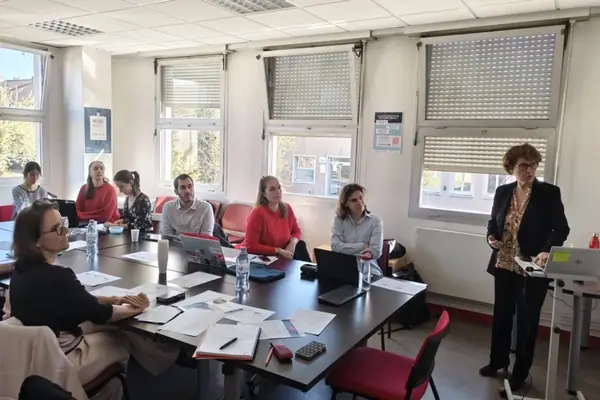
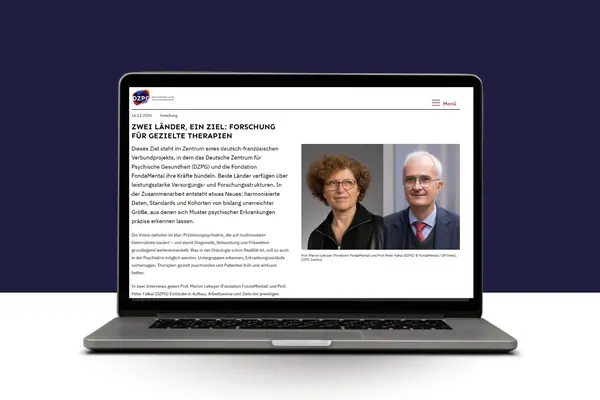
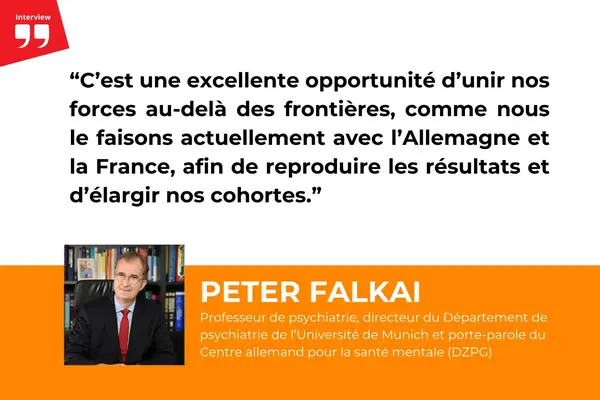
Two countries, one shared ambition: advancing precision psychiatry

ResearchJuly 2025
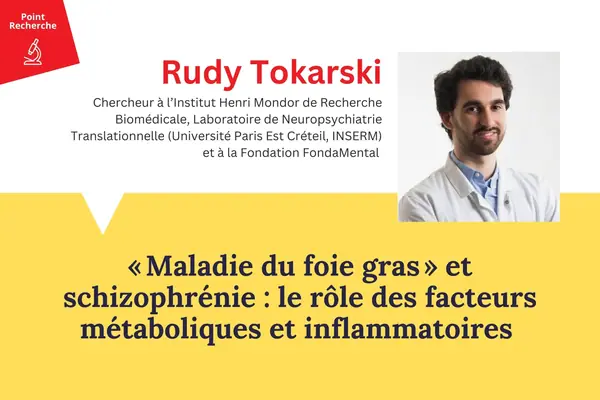
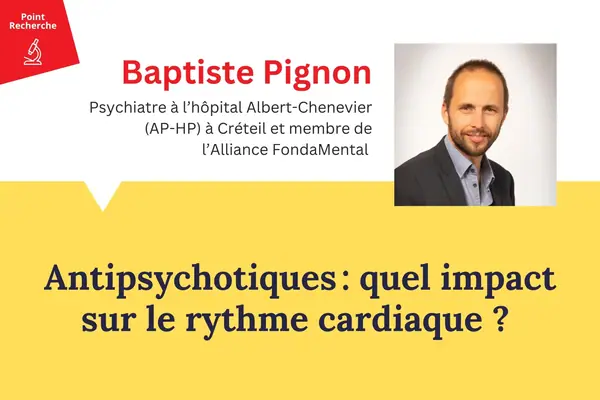
Antipsychotics: what impact on heart rhythm?
ResearchDecember 2024
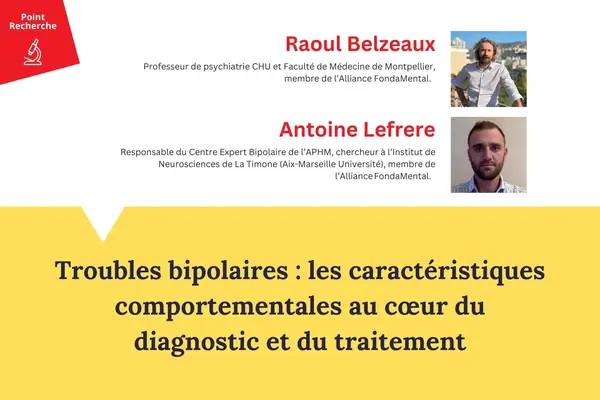
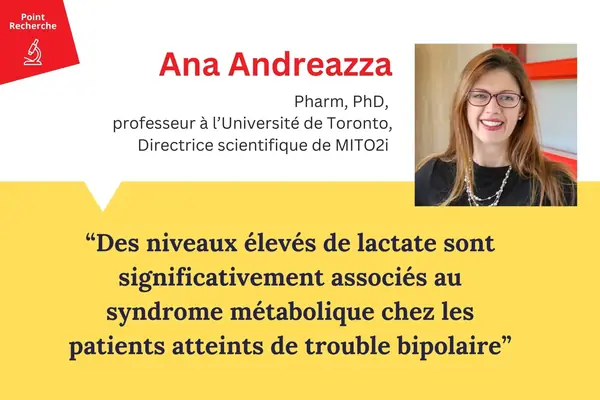
Bipolarities: a key to understanding
Other areas
Become a donor