
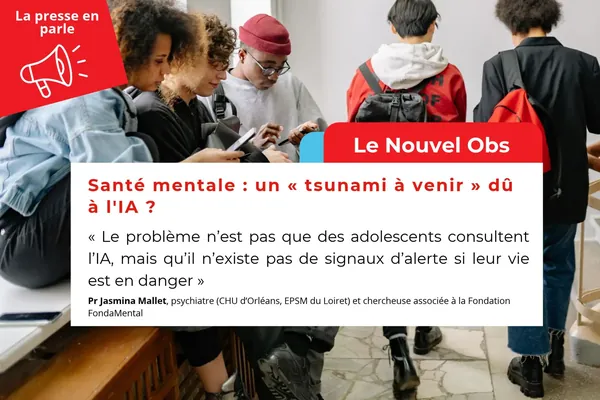
PressOctober 2026
Research area 6 of 10
The AI team at Fondation FondaMental builds and tests AI methods that help psychiatry treat each patient as an individual, not as a diagnostic category.

Why psychiatry needs AI
Two people with the same diagnosis of bipolar disorder or schizophrenia can look very different. Their symptoms, memory and attention, biology, life history and response to treatment may have little in common. Much of this variation is invisible to the diagnostic label, and the right treatment is often found by trial and error.
Psychiatry is also one of the hardest fields for AI. The information that matters is:
Our goal is therefore not only to predict, but to build models that represent this diversity, learn from rich and imperfect data, interact safely with patients and clinicians, and ultimately connect what we observe in patients to the mechanisms and treatments that matter.
We work on the deeply phenotyped cohorts of the FondaMental Advanced Centers of Expertise (FACE), including people with bipolar disorder (FACE-BD) and schizophrenia (FACE-SZ), followed across France with standardised clinical, cognitive and biological assessments.
AI at FondaMental
6,252
participants from the FACE-BD bipolar cohort used to build our synthetic data model
177
clinical, cognitive, biological and sociodemographic variables modelled together
11,000+
patients included in our stratification work
643
interview modules run by our AI agents during evaluation
Our research at a glance
Slide the diagram sideways to see all of it.
Each direction stands on its own. Together, they build toward treatment and monitoring that are personalised to each patient.
Synthetic data
We built VAE-DIFF, an AI model that generates realistic “synthetic patients”: artificial records that behave statistically like a real cohort, without belonging to any real person.
Why it matters. AI needs data, but psychiatric records are among the most sensitive data that exist. Researchers who could improve care often cannot access them, and every new collaboration requires heavy governance. Synthetic data offers a safer first door: teams can explore, develop and benchmark methods on synthetic cohorts, then confirm their results on the real data inside a secure environment.
What we did. We trained VAE-DIFF on baseline data from 6,252 participants of the FACE-BD bipolar cohort, covering 177 clinical, cognitive, biological and sociodemographic variables.
How it works, in brief. The model first learns a compact summary of each patient, then learns to generate new summaries, and finally turns them back into full records.
Slide the diagram sideways to see all of it.
What we found.
Fidelity · main objective
−81.7%
in MMD² compared with HI-VAE, the next-best method (−73.8% in Fréchet distance). The synthetic cohort is the closest to the real one.
Privacy
0.048%
of synthetic records were unusually close to a real patient record, with no exact copies.
| Question | Result |
|---|---|
| Does it look like the real cohort? | Lowest maximum mean discrepancy (MMD², 0.0064) and Fréchet distance (5.951) of all methods evaluated, versus 0.0350 and 22.712 for HI-VAE, the next-best method; best on 4 of 5 distributional fidelity metrics. |
| Is it useful for building models? | Models trained on synthetic data and tested on real patients largely preserved patient ranking for functional impairment (FAST); transfer to bipolar subtype classification was more task-dependent. |
| Does it keep the structure between variables? | The first five principal-component directions were broadly preserved; some clinically meaningful links, such as trauma and neurocognition, diverged more. |
| Does it protect privacy? | No copied records; nearest-neighbour distances close to a real held-out baseline; membership inference near chance. |
Synthetic cohorts are not meant to replace real ones. We see them as a governed computational access layer: a safe place to start, before confirmatory validation on secure real data.
Phenotyping
We use AI to describe each patient by where they sit along a small number of meaningful dimensions, rather than by a single diagnostic label.
Why it matters. Diagnostic categories capture only part of what distinguishes patients. If we can find the dimensions along which patients really differ, we can tell which features are shared across diagnoses, which define specific subgroups, and which are linked to functioning, illness course or treatment response.
a. Discovering subgroups. We apply unsupervised clustering, methods that group patients by similarity without being told the answer in advance. These approaches integrate clinical, cognitive, biological and sociodemographic information at once, including a multiplex graph-based consensus clustering approach applied to more than 11,000 patients.
b. Mapping patients onto dimensions. Using Bayesian factor modelling with an explicit missingness mask, we place each patient in a 10-dimensional latent space. In plain terms, a large number of measurements are summarised into ten underlying axes, and the model handles missing measurements honestly instead of guessing them away. This map lets us:
Slide the diagram sideways to see all of it.
This is a step from categorical diagnoses toward a richer computational portrait of each patient: one that integrates several levels of information and can be updated as new data arrive. It also provides the building blocks for prediction, longitudinal modelling and treatment stratification.
AI-assisted care
We built a multi-agent AI system that can conduct a full structured psychiatric diagnostic interview, the M.I.N.I. (Mini-International Neuropsychiatric Interview), and a framework to judge whether such a system can be trusted.
Why it matters. Mental disorders are increasingly common, and access to specialised psychiatric care is limited. This contributes to significant delays in diagnosis and treatment worldwide. AI agents could help expert centres screen more people, collect structured information before a consultation, and follow patients between visits.
What makes it different. Most uses of large language models (LLMs) in medicine take a fixed text and output an answer. Our system instead conducts the interview: it decides which questions are relevant based on previous answers, moves between modules, and coordinates several specialised agents to reproduce the sequential, adaptive nature of a real clinical assessment.
Slide the diagram sideways to see all of it.
Evaluating trust, not just accuracy. A system that talks to patients raises safety questions that a prediction model does not. We therefore evaluate it on four dimensions:
| Dimension | What we ask |
|---|---|
| Clinical validity | Does it reach the right conclusions and follow the interview correctly? |
| Patient-centred trustworthiness | Is the interaction respectful, clear and appropriate for the patient? |
| Operational safety | Does it behave safely across the whole conversation, including when things go off-script? |
| Deployment readiness | Is it reliable and robust enough for real clinical settings? |
What we found.
4
large language models tested
30
simulated patient profiles
643
interview modules executed
We tested the system on simulated patients with bipolar disorder, schizophrenia or no psychiatric disorder. Performance varied substantially by model and by task. Gemini 2.5 and GPT 5.6 Luna performed best overall in this evaluation, while DeepSeek 4.1 and GPT 4.1 nano showed different strengths and weaknesses.
The broader lesson: deploying agentic AI in psychiatry requires evaluating not only the final diagnosis, but how the system conducts the interaction, adapts to the patient, handles uncertainty and behaves across the full assessment.
Where we are heading. We will extend agentic AI to many uses in expert centres, from initial screening to supporting clinicians and helping patients. Our target is a hybrid model of care: AI supports continuous assessment, structured data collection, longitudinal synthesis and early warning, while clinicians keep responsibility for interpretation, complex decisions and the therapeutic relationship.
Clinical language models
We aim to fine-tune large language models so that they reason about psychiatric cases the way experienced clinicians do, not just produce plausible-sounding answers.
Why it matters. General-purpose LLMs know a lot of medicine, but psychiatric reasoning is specific: weighing overlapping symptoms, respecting diagnostic criteria and their exceptions, considering course over time, and knowing when information is insufficient. A model that gets the right answer for the wrong reasons is not safe to put in front of patients or clinicians.
What we are working toward.
These specialised models are a natural engine for our clinical agents (section 03): better reasoning makes the interview more accurate, more transparent and easier for clinicians to audit.
Looking ahead
Our long-term goal is to help each patient receive the treatment most likely to work for them, and to follow how they evolve so that care can be adjusted before problems escalate.
From snapshot to trajectory. A diagnosis describes a patient at one moment. We are developing models that represent how a patient’s clinical state evolves over time: where they are today, the trajectory they are on, and the factors associated with changes in that trajectory.
From many sources to one picture. Multimodal representation learning will let us combine clinical, cognitive, biological, environmental and potentially digital phenotyping data (smartphones, wearables) into a coherent picture, even when some sources are missing for a given patient. Foundation models trained across cohorts are a promising route to such representations.
From prediction to mechanism. Predicting an outcome is not enough to change it. By combining foundation models and generative approaches with statistical and causal methods, we aim to separate features that are merely associated with an outcome from those that may be modifiable mechanisms or treatment targets.
What it could enable.
Slide the diagram sideways to see all of it.
The ambition is not to replace clinical judgement, but to give clinicians and patients better tools to choose treatments and follow their evolution over time, linking phenotype and trajectory to mechanisms and treatment response.
How we work
AI supports assessment, data collection and synthesis; clinicians keep responsibility for interpretation, decisions and the therapeutic relationship.
We measure fidelity, utility, privacy, safety and robustness, not only a headline score.
Real patient data stay in secure environments; synthetic data and secure infrastructures open safe routes to collaboration.
Our methods are developed and validated on the FACE cohorts, followed in the FondaMental Advanced Centers of Expertise across France.
We welcome collaborations with clinical teams, AI researchers and industry partners who share the goal of a more precise, more personal psychiatry.
Contact the Foundation
Andrii Kulakovskyi
Chief Technology Officer, Fondation FondaMental (PhD)

Léah Camarcat
AI research engineer, Fondation FondaMental (PhD)
Every donation can be earmarked for a specific project. These are the projects under way in this area.
Artificial intelligence
Recent advances in artificial intelligence open up an unprecedented opportunity for precision medicine. Psychiatry, which still has few validated tools to make use of the complexity of its data, could be particularly transformed by these new approaches.
See the projectPressOctober 2026
PressSeptember 2026

Event20 November 2026
PressApril 2026

VideoDecember 2025


Press releaseMarch 2025
Become a donor