
International cooperation
Franco-British consortium: biomarkers
- Period
- 2024 > 2030
- Research area
- Biomarkers
The UK-French Mental Health Biomarkers Consortium brings together PEPR PROPSY and the UK NIHR Mental Health Translational Research Collaboration, to speed up the discovery and validation of biomarkers for mental disorders, starting with blood-based biomarkers. On the road to precision medicine in psychiatry.
Donate to this project
This project is only partly funded today. With your gifts, precision psychiatry can move the cure of mental illness forward. Individual or company, every contribution counts: together, let’s make this hope a reality.
Our institutional and corporate supporters
 Wakam · private sponsorship, Precision Mind Prize
 NIHR · public funding, United Kingdom
The challenge
- There is no health without mental health (WHO, 2020), and without health there can be neither economic nor social success. Mental disorders have been the leading cause of disability worldwide since 2020, affecting 1 person in 6 in the WHO European Region (WHO Europe, 2026). They shorten life expectancy by 15 to 20 years and account for 35% of the global burden of disease, at an estimated cost of 4% of European GDP (€600 billion).
- In the United Kingdom, the MH-TRC (Mental Health Translational Research Collaboration) has been structuring translational research in mental health since it was created in 2017, with major funding from the National Institute for Health and Care Research and the Mental Health Mission. The aim is to broaden research into mood disorders, early psychosis and young people’s mental health, by strengthening the involvement of the life sciences and of pilot sites in Birmingham and Liverpool.
- In France, the cost of mental disorders rose from €109 billion in 2009 to €163 billion in 2018. With €23 billion in annual spending, they exceed cardiovascular disease and cancer.
- Yet only 2% of the public medical research budget is allocated to psychiatry, despite major advances in research and innovation.

Our strengths
- Current classifications of mental disorders rest on heterogeneous diagnoses, which limits the identification of effective treatments. Integrating objective biomarkers – blood-based, brain imaging and digital – would make it possible to refine these diagnoses and improve patient care.
- In recent decades, research in France and the United Kingdom has made major advances in this field. It is now essential to validate these biomarkers across existing databases and cohorts, in liaison with the regulatory agencies.
- To accelerate this transition: the creation of a Franco-British public-private partnership bringing together universities, charities, and pharmaceutical and technology companies, starting with blood-based biomarkers. This collaboration will foster synergies between researchers and lead to concrete advances in precision psychiatry.
Objectives
- Aim: to integrate objective biomarkers into psychiatric classifications, to improve diagnosis and develop targeted treatments.
- Advances: French and British teams have identified blood-based, brain imaging and digital biomarkers, which require validation and regulatory approval.
- Partnership: creation of a public-private consortium bringing together universities, charities, and pharmaceutical and technology companies, with an initial focus on blood-based biomarkers.
- Data access: setting up a cohort club to centralise access to mental health databases, make access requests easier and enable secure analyses.
- Harmonisation: defining common criteria for blood sampling and adopting standardised techniques (genomics, proteomics, immunology) between France and the United Kingdom.
- Collaborative research: launching Franco-British projects on the mechanisms of mental disorders, including immunogenetics, inflammatory dysfunction and immune metabolism.
The official creation of the consortium
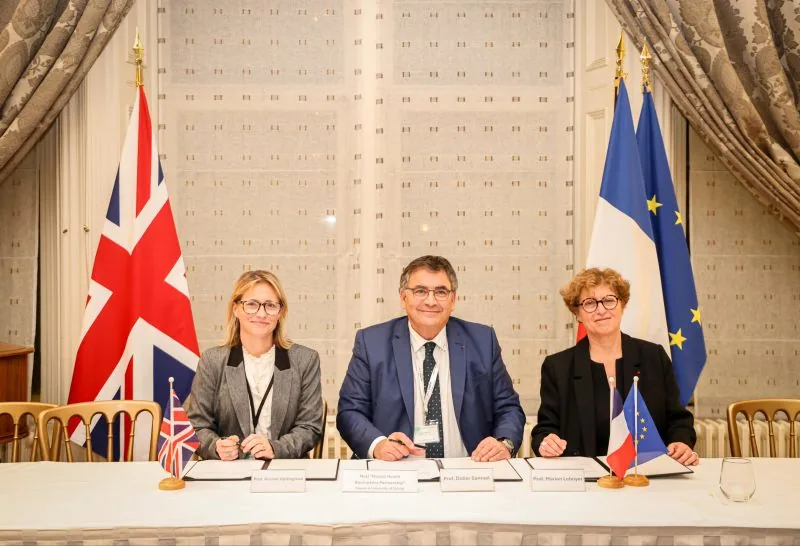
- The Memorandum of Understanding (MoU) establishing the consortium, under the framework of the French Priority Research Programme PEPR PROPSY and the NIHR, was signed on 27 October 2025 at the French Embassy in London.
- It was signed by Prof. Didier Samuel (President, Inserm), Prof. Rachel Upthegrove (University of Oxford) and Prof. Marion Leboyer (UPEC, Fondation FondaMental).
- In May 2026, the consortium was named an official deliverable of the Franco-British Dialogue for Science & Technology, the “Comité Mixte 2026”: “The Consortium will develop a shared data platform for cross-border research on biomarkers and patient stratification, and launch pilot projects to validate them and integrate them into clinical practice.”
The first winners of the Precision Mind Prize
- The prize follows in the footsteps of the consortium devoted to biomarkers of neurodegenerative diseases (Dementia Discovery Fund), which helped identify blood markers of Alzheimer’s and Parkinson’s diseases. Psychiatry can and must achieve the same success.
- Winner no. 1, Wakam award — AUTOSCREEN: when the immune system attacks the brain, detecting psychoses of autoimmune origin. Dr Adam Al-Diwani (University of Oxford) and Dr Laurent Groc (CNRS, University of Bordeaux).
- Winner no. 2, NIHR MH-TRC award — The immuno-metabolic profile of anhedonia: why do some patients no longer feel any motivation or pleasure? Dr Mireille Laforge (NeuroDiderot, Inserm, IHU-ICE Robert-Debré, Paris) and Dr Fabiana Corsi-Zuelli (University of Oxford, UKRI-MRC).
Key dates
September 2024
Summer school in immunopsychiatry at King’s College, London
3-4 February 2025
Launch meeting of the consortium at the University of Oxford
27 October 2025
Signature of the Memorandum of Understanding (MoU) establishing the consortium, at the French Embassy in London
November 2025
Launch of the Precision Mind Prize, by Wakam and Fondation FondaMental
13-14 April 2026
Spring school and gala dinner in London; on 13 April, the first winners of the Precision Mind Prize, chosen by an independent scientific committee, are announced
May 2026
The consortium is named an official deliverable of the Franco-British Dialogue for Science & Technology (“Comité Mixte 2026”)
24 November 2026
Fundraising dinner at the French Ambassador’s residence in London
Project leaders
Pr Marion Leboyer
INSERM, AP-HP, UPEC, Chief Executive Officer of Fondation FondaMental
Pr Rachel Upthegrove
MMBE, MBBS, MPhil, PhD, FRCPsych. Professor of Psychiatry, Department of Psychiatry, University of Oxford. Director, Oxford Health Biomedical Research Centre.
Pr Husseini Manji
University of Oxford, Duke and Yale Universities, co-chair of the UK Mental Health Mission
Partners



Become a sponsor of the project
By funding this project, you make concrete progress possible for the people affected and those close to them.
- Your contribution will be proof of your commitment, which you can highlight in internal and external communication and for your employer brand.
- Fondation FondaMental will acknowledge your support on all its communication materials and in all its publications, in France and internationally. Our team also offers information meetings for your employees, your clients and, more broadly, all your stakeholders.
- Added to this is the tax advantage provided for this type of sponsorship, which Fondation FondaMental, given its status, can offer you.
- These counterparts are proposals and can be added to.
News, podcasts and conferences on this subject
In the press
Other projects to support
Biomarker research
Immunology and mental illness
Immunopsychiatry is a new window on the neurobiology of major psychiatric disorders: it sheds light on the mechanisms behind them and makes it possible to identify and develop innovative preventive or curative treatments. Each project has its own page: autoimmune psychoses, the HERV-W retrovirus, metabolic psychiatry, the gut-brain axis, proteomics, interleukin-2 and photobiomodulation.
Research area · Biomarkers
See the projectBiomarker research
Genetics and mental illness
Analysing the genetic markers of the patient cohorts assembled over fifteen years across the Expert Centre network, to better understand the mechanisms of mental illness and open the way to genetic diagnosis, as has been done in oncology.
Research area · Biomarkers
See the projectBiomarker research
Brain imaging and mental illness (Iseult 3)
A clinical research project to study the brains of people living with psychiatric disorders using the world’s most powerful MRI scanner: ISEULT.
Research area · Biomarkers
See the project
Become a donor